

Menu
Dealing with Grade Changes
What happens if you are running your fence along flat terrain and suddenly the grade changes? Obviously, half-measures like fence stakes won’t help here. You have to realign the fence to follow the new grade.
Do this by installing a post at about where the maximum slope change happens and cutting the fence just after it passes this post. Then angle the next length of deer fencing up or down as much as necessary to make a straight run to the next post, following the new grade. Be sure to leave enough material along the bottom to create a six-inch bottom fold.
If you are going around a curve, you will find that the bottom fold needs to be cut at one or more posts along the curve in order to allow the fencing to comfortably negotiate the curve. Also, when going around a corner you will generally find that this has the effect of changing the lay of the land, and so you will need to cut your fencing a few inches beyond the corner post and establish a new run of fencing starting at that corner which follows the new grade.
Using Fence Stakes to Secure the Fence Bottom
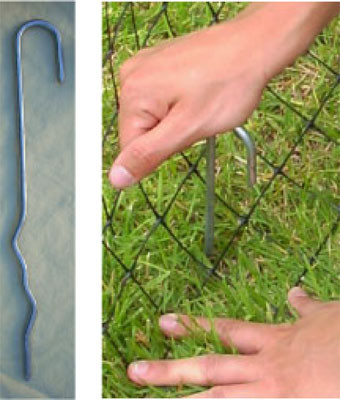
One of the most common errors of deer fence installers is to focus so much on how tall the fence will be that they neglect its bottom. But the bottom is precisely where the deer usually get through. So for starters, it is essential to leave a 6-inch fold of fencing material extending outward (toward the deer) on the bottom. This fold should be firmly secured with ground stakes.
Use the 12-inch kinked galvanized ground stakes for most kinds of soil, reserving the longer 18-inch hooked rebar ground stakes for soils that are light, dry, or sandy. Both types can be spaced up to 6 feet apart, at the place where the fencing first hits the ground, and can be supplemented with rocks when suitable rocks are available. In general, it is both easy and useful to pin this staked-down bottom fold close enough to the ground to keep it out of the way of lawnmowers.
Regarding the addition of a metal hexagrid bottom guard, the resulting plastic-metal deer fence combination should offer no open seam for exploration by would-be intruders and should be adjusted for all grade changes.
The metal bottom guard should be kept on the outside (toward the deer). The upper 18 inches of this bottom barrier should be firmly attached vertically to the bottom of the main fencing with nylon zip-lock ties or hog ring staples (using roughly one tie or staple per square foot); and the bottom 6 inches should folded outward on the ground and staked down with ground stakes.
Should there be an extra 6 inches of the main fencing left at the bottom of the fence, this should be folded out together with the lower 6 inches of the bottom guard (if there is one) and staked down at the same time.
Warning Flags: A Mild Deer Repellent
For your deer fence to be most effective, as noted earlier, it needs to be practically invisible to deer. But you don’t want deer to bump into it at twilight and then decide to charge this invisible object, because that may break even the strongest deer fence. Nor do you want them to run into the fence and begin to explore it, because that makes them more likely to become familiar with it and become comfortable probing its defenses. Instead you would like the fence to act like a deer repellent.
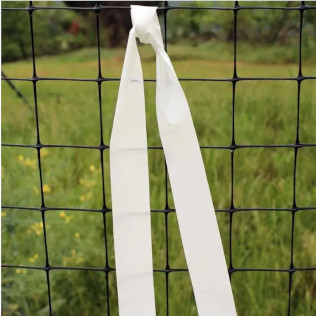
To get a mild deer repellent effect, it’s a good idea to warn the deer off with a danger signal that gives them the fence’s location but not its height. Do this by putting strips of white surveyor’s tape (“warning flags”) on the deer fence. Place each strip about waist high (at about 3 feet) and tie one end to the fence with a knot, arranging things so that the other end hangs downward for about a foot on the outside of the fence, which will allow it to blow freely in the wind. These deer repellent “flags” should be placed about 10 feet apart.
What this does is create a highly visible sign that mimics the white-tailed deer’s raised white tail–this being a natural danger signal for this species that says, in essence, “get away.” These flags will show roughly where the “invisible” fence runs, but so long as the markers are only placed about three feet above the ground, they will reveal nothing about the deer fence’s actual height.
Far from being incidental or optional add-ons, these markers are an important part of any deer fence during the period immediately following its installation. After three or four months, however, if one wishes to remove them for reasons of appearance (once the deer have become accustomed to the fence), they can be taken off.