

Menu
Fence Braces: Do You Need Them?
The aim of fence braces is to counter sideways stress. If your fence weighs a lot, or there’s a snow load on it, or a tree branch falls on it, the fence will experience sideways stress. If the stress is too strong it can tilt or bend the corner posts, as well as a bunch of line posts; so that’s definitely something to avoid.
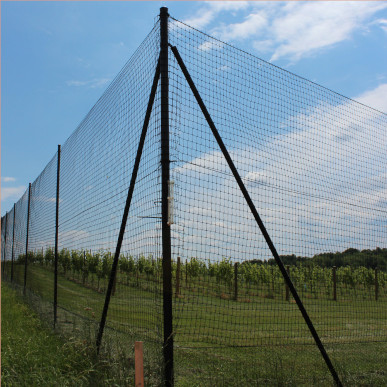
A good way to avoid it is with fence braces at the fence corners and ends. Put an earth anchor or braced post at or near each corner and end (an “end” being a place where the fence butts up against a building, wall, or other fence). Then, when a sideways stress comes down the line it won’t do any harm because the fence braces will counteract it and nothing will move. Your fence will be protected.
The question then becomes, Do you really need this protection? The answer is “Not in all cases.” For instance, where you are using trees as posts corner bracing is not needed because the trees won’t move — and so they will provide any necessary bracing. Likewise, if no great sideways stress is likely you don’t need fence braces. Suppose your fence is short, protecting a small garden, and not in the way of falling branches. Then chances are it can deal with modest amounts of snow without bracing. As a rule of thumb, straight deer fence runs 30 feet long or less, even in snow-prone areas, don’t need bracing.
Choosing between Earth Anchors and Brace Posts
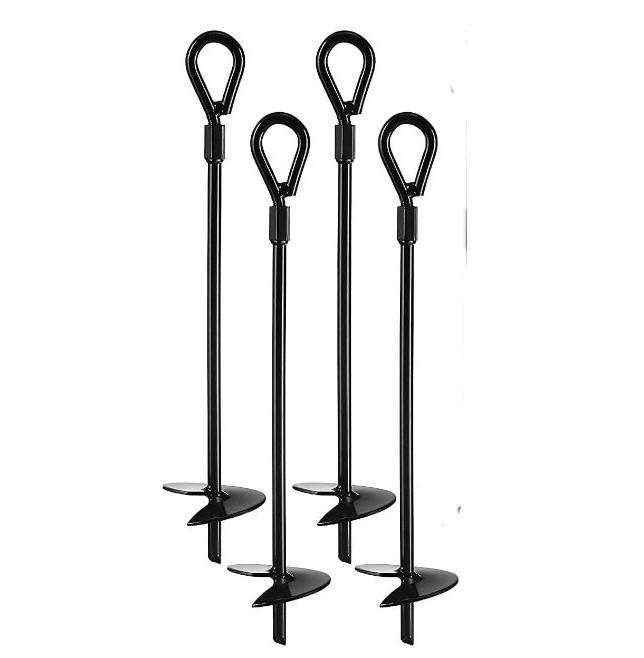
In cases where you do need bracing, the best and least expensive bracing is provided by earth anchors. They are strong (with an estimated pullout strength of about 2,000 pounds) and nearly invisible (all you see is an inch-long nub of a handle, a wire, and a metal band atop the attachment post). They’re also easy to install and cost little.
In contrast, the cumbersome corner and end brace posts sold by most vendors (we also offer them) are expensive, highly visible, and harder to install.
Installing Earth Anchors
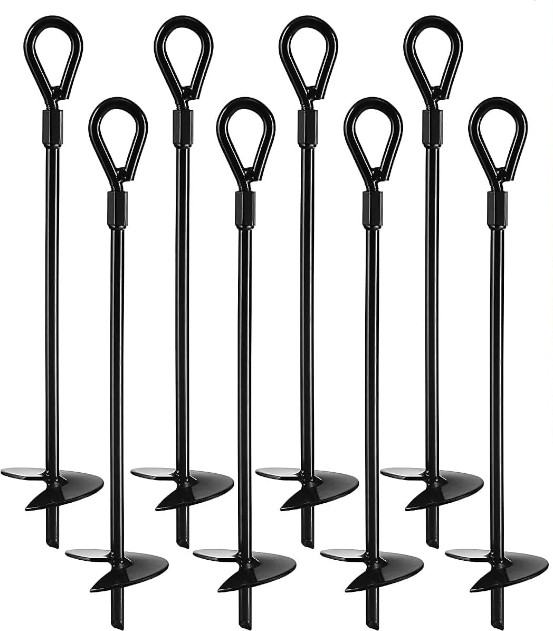
Install earth anchors after your fence posts are set up but before the fencing is in place. (You will need two anchors for each corner and one for each end).
To install an anchor, get a strong metal rod 2 to 3 feet long and put it through the earth anchor’s handle. Then screw the anchor into the ground right along the fence line at about a 45 degree angle, halfway between the corner/end post and the first post back, heading toward the corner/end post.
When the anchor has been screwed well into the ground so that only its handle loop is showing, stop and attach a brace band at the top of the first post back from the corner/end post, with its flanges pointed toward the earth anchor.
Then attach a strong wire to the anchor’s handle and the brace band–by passing the wire through the handle loop, applying a crimp, and tightening the crimp with a crimping tool; and by passing the other end of the wire under the bolt in the brace band atop the attachment post, pulling the wire taut, and applying another crimp.
That’s all there is to it, except for two things we have omitted. First, you need to do this on both sides of any corner. So for each corner you will need two earth anchors, two brace bands, two lengths of wire, and four crimps. Also, if you anticipate major snow loads or other prolonged stresses, it is a good idea to put all posts to which earth anchors will be attached into cement footings. That way these posts cannot be driven downward by the stress.
Installing Corner and End Brace Posts
In the case of an end brace post system, which has a main (vertical) post plus an angled side-post and comes as a kit, start by Installing the sleeve for the main (vertical) post of this two-post kit in a cement footing. Next, find the angle at which you want your angled side-post to be installed, where you want it to be attached to the main post, and where you want it to reach the ground. Starting at the place where you want it to reach the ground, use a post-hole digger to create an angled hole suitable for placing the sleeve in a cement footing. Then set the sleeve in a cement footing and (before the cement dries) insert the angled post into the sleeve and attach it to the main post with the hardware provided in the kit. (In the case of a corner brace there will be two of these angled side posts and two cement footings.)
Avoiding Cement Footings
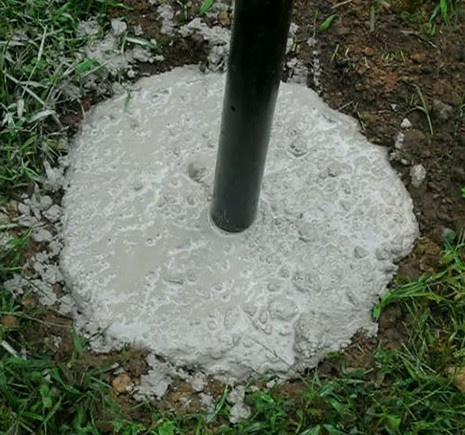
We no longer recommend lots of cement footings. Here’s why: If a pull or load on your fence is sufficient to tilt posts lacking cement feet, then it’s likely to bend those same posts when they have cement feet–and tilting is easier than bending to correct.
In this vein, current knowledge says it’s best to put your posts close enough together and do enough bracing (assuming the fence will face snow loads, falling limbs, or repeated deer impacts) so that tilting or bending is unlikely. Then limit your cement footings to brace posts whose angled support posts are placed the ground at an angle (see above), anchor posts (those posts to which an earth anchor’s wire is attached), and to gates.