

Most people think putting a deer fence on a hill is a big problem. The truth is, it usually isn’t. Unless the hill is very steep, you don’t need to worry. And even on steep slopes, only a few simple fixes are needed. My purpose here is to show you why hills don’t have to stop you from building a strong deer fence.
Tensioning
Are you worried about how to install a deer fence under high tension when the grade changes? If so you’re not alone. Many of our customers have asked about that. However, none of our deer fences are installed under high tension. Once the posts are up, the fencing is simply pulled taut manually by a single person exerting little effort. Even installing a top support line does not involve high tension. That’s because the line only applies enough tension to keep the fencing from sagging, to make it run straight, and to ensure that it looks good.
Dealing with Hills
This lack of high tension makes dealing with anything less than precipitous hills simple. Let’s say you’re installing a deer fence for hilly terrain on a downward-sloping hill, with the top side of the fence being on ground that is more or less flat. In that case, when you reach the corner and turn to go down the hill, you cut the fencing at the corner and attach it to the corner post. Then you start a new run of fencing following the new grade down the hill. It’s that easy.
Dealing with Other Grade Changes
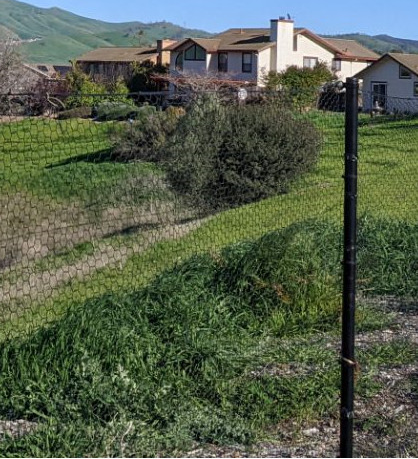
Well than, what about a change of grade in the middle of a straight run of fencing? In that case you do pretty much what you did at the corner. Choose the place where the grade change appears greatest and install a post there. Then, end your incoming run by cutting the fencing at that post and starting a new run following the new grade. That’s all there is to it.
Dealing with Ground Irregularities
This leaves us with the last small part of the picture. How does one handle minor ground irregularities? These are brief irregularities that don’t merit the name of grade changes but that leave small spaces of an inch or so showing under the fence. It’s important to deal with these, because deer don’t want to go over a tall fence,; they want to go under it. If they find one of these irregularities they’re likely to poke their noses in and get under the fence. They’re good at doing that.
There are various answers, but the easiest one is to fold out 6 inches or so of fencing toward the deer at the bottom of the fence and to stake it down with ground stakes, keeping the ground stakes six feet apart or less. (The stakes are not expensive.)
Coping with Really Steep Slopes
Most slopes involving deer fences for hilly terrain are fairly friendly. They don’t require pitons. Indeed, on most hills the ground drops less than two feet for every ten feet of fence.
But let’s say you have a really steep slope where the ground drops three or four feet for every ten feet of fence. In that case an odd thing happens. Suppose, for example, that you’re installing 8-foot wide deer fencing with a 6-inch bottom fold on 7.5-foot posts. In that case the 7.5-foot posts should accommodate the remaining 7.5 feet of fencing. Right? Only they don’t. If you stick rigorously to the 6-inch bottom fold, the fencing reaches slightly above the top of the post because it is following the lay of the land while the post is installed vertically.
What you are encountering is perhaps the first practical problem in trigonometry since you left high school. You can start doing the math by estimating the angular grade of the hill in degrees and finding its cosine. Or you can install a post vertically on the hillside and lean a roll of fencing up against it, keeping the fencing at about the same angle it will be following as it runs down the hill. If the slope is steep enough to merit this attention, you’ll be able to see about how much the fencing rises above the post.
Fortunately, there is an easy answer. All you need do is attach the fencing to the tops of your posts and increase the width of the bottom fold by however much seems right. Disappointingly for would-be trigonometry students, no math is needed. In the case of very steep slopes, of course, all this can reduce the height of your fence a bit; but in cases where this reduction is significant, the sheer steepness of the slope will make deer more reluctant to try a jump, and so things tend to balance out.
Which Deer Fence to Use
Regarding which deer fence to use for uneven terrain, as the foregoing suggests it doesn’t much matter. Plastic deer fencing is very light and hence somewhat easier to install on steep slopes. However, metal deer fencing is also light (typically less than 80 pounds per 100-foot roll). And while installing it on a slope may be a bit more trying than installing plastic fencing, the difference is no game-changer.
Conclusion
In general, hilly terrain is no impediment to deer fencing. Physically, it may make installation a bit more challenging; but no drastic installation procedures or techniques are needed.