

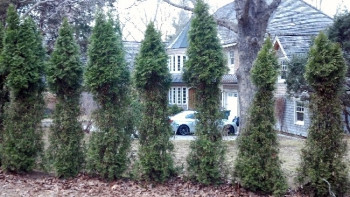
Deer got you down? Specifically, are deer decimating the landscape plants set in years ago to decorate your yard? And is the yard’s appearance suffering big-time as a result?
Well, there are answers. They aren’t perfect answers, but they work. So it’s worth taking a few minutes to review those answers and examine the pros and cons.
The two readily available answers are repellents (including motion-activated water sprayers and noisemakers) and deer fences (including electric fences). However, we can pretty much rule out water sprayers and noisemakers because (1) they generally don’t cover sufficient ground and (2) the deer get used to them. Similarly, we can mostly rule out electric fences because homeowners don’t like exposing themselves, their families, and their visitors to possible electric shocks. That leaves us with sprayed-on chemical repellents and barrier deer fences.
Deer Repellents
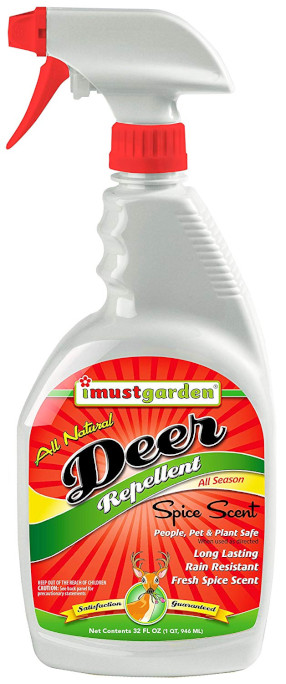
Most people don’t want to take on the job of applying deer repellents to their yards. They have other commitments, and so they can’t or don’t want to devote the time or acquire the knowledge needed to do it well. And if it’s not done well (on time with the right repellents, changed periodically to keep the deer from getting used to them) it may not work.
Hence, for most people with landscaping to protect, applying repellents means hiring professional applicators. That’s expensive, not because individual treatments are expensive (typically $100 to $200 per acre), but because the applications need to be repeated roughly every 4 to 6 weeks – implying a yearly cost usually in the range of $900 to $2,600 per acre. On the other hand, there’s no big up front cost. So, for many people, especially where the deer pressure is low, repellents offer a good answer.
Deer Fences
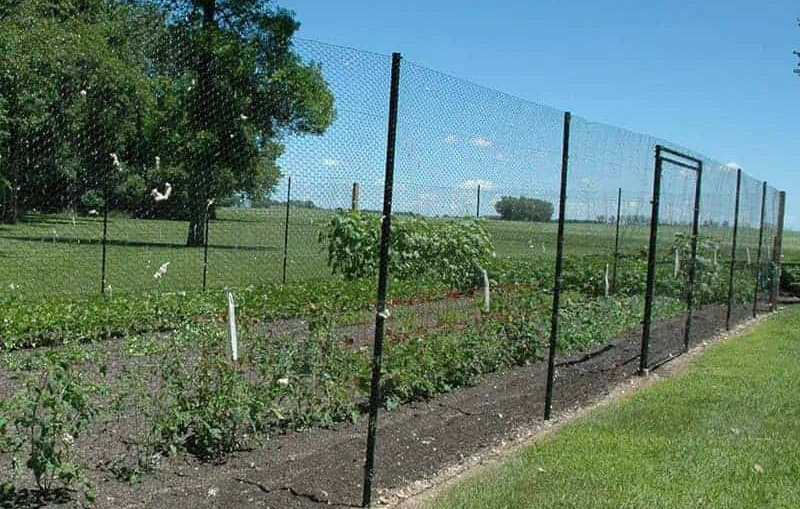
Well then, what about barrier deer fences? They work. In fact, well-planned barrier deer fences have a better record of success against deer than repellents. There’s no need to have applicators making frequent visits to apply repellents. And while the initial cost of materials is high ($7 to $10 per linear foot), deer fences last a long time (typically 10 to 20 years); and so, compared to the minor annoyance and repeated application of repellents, their cost is low.
The main thing, if you’re installing a deer fence and watching your budget, is to avoid inadequate posts (such as rebar or PVC posts) and also to avoid weak plastic fencing (with a breaking strength of less than 650 pounds per linear foot). For those installing plastic fencing, it’s also important to install a bottom guard; and, if you don’t want the fence to sag, to install a top support wire. All these things can generally be done without going outside the $7 to $10 range.
Other downsides of deer fences, ones that they share with all fences, relate to access and visibility. That is, they reduce access to the property they protect, and they interfere with attractive views. However, well-designed deer fencing typically fades into near-invisibility at distances as short as 10 or 15 feet. And if access is a problem, just as access through any fence can be a problem, it is often possible to arrange the fence and its gates in ways that reduce the access issue.
On the positive side, deer fences used to protect landscaping also have an important benefit in areas (mostly in the northeast) where deer ticks and Lyme disease are common. That is, the deer fence can be a major tool – indeed a critical first step – in the battle against deer ticks and Lyme disease transmission, and so it can go a long way toward securing the yard’s safety.
Conclusions
Overall, there appear to be two important tools available for protecting a home’s landscaping from deer. One is deer repellents and the other is deer fencing. Within this context, it’s fairly common for people to try repellents first; and then, if the repellents fail, or the repeated applications prove too costly or inconvenient, to look to the deer fence as a more permanent, reliable, and cost-effective answer.