

Let’s be frank. We’re in the deer fence business, so we favor fences. But that’s partly because we know the limitations of other methods. Deer-resistant plants may discourage deer, but they won’t protect a small garden, or even themselves, if the deer are really hungry. Likewise, repellents (including chemicals, noisemakers and water sprayers) have a blind spot. The deer get used to them; and once they do (you won’t know when) the garden gets it.
Well then, what about electric fences? An electric fence set up right and maintained daily has a good chance of protecting your garden. But maintenance aside, most gardeners don’t like the idea of getting shocked or having a fence around the garden that might shock others. So electric fences have not found favor in the gardening community.
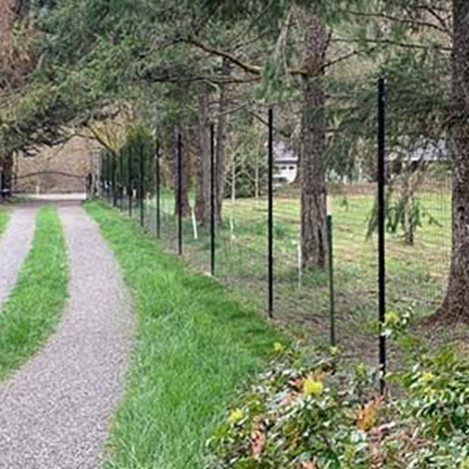
That leaves barrier deer fences. Set up right, a barrier deer fence will reliably deer-proof your garden. The main drawback is its cost. However, ways exist to reduce that cost dramatically. Specifically, the three parts of a barrier deer fence that cost big money are the posts and braces, the fencing, and the gate. So let’s take a look at those.
How to Save Money

The posts we sell, designed to last and to give your fence a finished suburban or estate look, cost quite a lot. So forget the suburban/estate look. Get studded steel T-posts from Tractor Supply or Home Depot. They’re a lot cheaper. They’ll have a farm/ranch look, but that’s often okay around a garden. Just be sure they’re two feet longer than your fence is tall, because you need two feet of each post in the ground. And space them out as far as reasonable (15 feet in regions without snow, 10 feet in snow-prone places) to cut costs even more. Suitable T-posts are rated by weight at 1.25, 1.33, or 1.5 pounds of post per foot.
Regarding corner and end braces, avoid the expensive corner and end brace posts sold by ourselves and other vendors. Instead use the earth anchors we offer. They are just about invisible when installed; they work better than the brace posts; they cost less; and they can be arranged so that no earth anchor cable hangs outside the fence.
Then get plastic fencing. It won’t last as long as metal fencing, but it costs less. If you want the fence to look neat, get an inexpensive top support wire. And if you’re not willing or able to inspect the fence daily for rabbit holes (holes that the deer will poke their heads into and use to penetrate the fence) get a bottom guard – a two foot strip of metal fencing installed toward the bottom of the fence.
I’m not much help regarding gates. Our gates (which come as easily assembled kits) cost over $200. However, if you make your own gate, it will probably cost more. And if you try to jury-rig something simple that will keep your fence deer-proof but admit people, it probably won’t work.
Deer-Proofing Your Fence
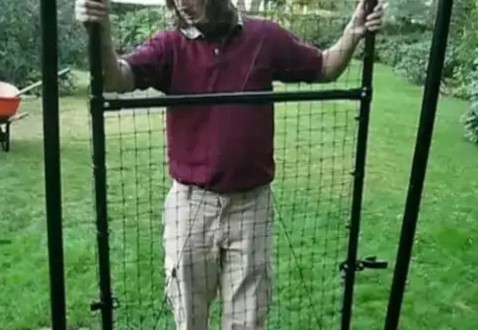
Before turning to costs, I said that “set up right, a barrier deer fence will reliably deer-proof your garden.” So here are some tips about how to set your fence up right.
- Make it tall enough. Contrary to the literature, you don’t need an 8-foot fence. In virtually all cases a 7-footer will reliably keep out deer. Indeed, there’s growing evidence that in many cases a 6-footer will do it. So, if your homeowner’s association won’t approve anything taller, by all means go ahead with a 6-footer. However, if you’re looking for strong deer-proofing reliability and can put up a 7-foot fence, I recommend a 7-footer.
- Use good posts. Our own handsome black galvanized round posts are fine, and so are studded steel T-posts in standard weights (1.25, 1.33, and 1.5 pounds per foot). But steer clear of U-posts, PVC posts, rebar posts, and so forth. They can spell trouble.
- Avoid Weak Plastic (Polypropylene). The market’s full of really cheap plastic deer fencing that doesn’t work. The deer walk right through it. So be sure to get plastic fencing that’s strong enough, with a breaking strength of 650 pounds or more per linear foot. If the web page or package does not say that, don’t buy it.
- Don’t Forget the Bottom Guard. If you have a plastic fence, rabbits and/or groundhogs are likely to gnaw holes at the bottom of the fence. Deer often find these holes, poke their heads in, break a few corner bonds, and use them to penetrate the fence. What prevents this is a bottom guard (a 2-foot strip of metal hexagrid fencing attached to the bottom part of the plastic fencing). So, if you use plastic fencing and have rabbits or groundhogs around, get a bottom guard.
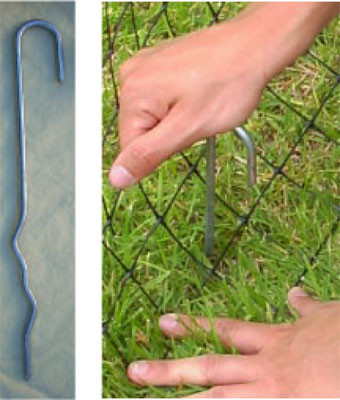
- Create a bottom fold. If a deer fence gets penetrated, it’s usually because the deer have squiggled underneath. They’re good at that. So don’t leave the bottom unprotected. Fold out six inches to a foot of your fencing or bottom guard at the bottom, toward the deer, and stake it down with foot-long ground stakes. That will reliably protect the fence’s bottom.
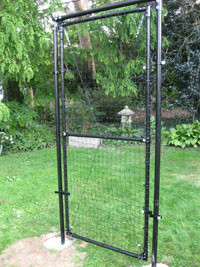
- Don’t Scrimp on the Gate. Be sure your gate is deer-proof. Remember, deer are really good at finding weaknesses in a fence. If your gate has a weakness, chances are they’ll find it.
All this seems pretty simple. Well, it really is simple, because deer fences are not complex. That is, they may seem a bit strange, but they’re not rocket science. They just involve a few unfamiliar materials. Assembling and installing them is rather easy. And indeed, if you follow the basic rules above, with minimum effort you should be able create a garden fence that will reliably keep out deer.