

Clear Signs
Let’s start with obvious signs — ones so obvious that you’re saying “the previous owners should have put up a deer fence” or “I should have gotten a deer fence kit last year.” That’s what you’re likely to say if your vegetable garden disappears, or if your landscape plants get devoured, or if your yard becomes rife with ticks. So let’s take these one by one.
Gardens
Deer are big animals, and most suburban vegetable gardens are small. So a single visit to a vegetable garden by browsing deer can be a big event. From the gardener’s standpoint It can be the biggest event of the season. It can make the garden pretty much disappear.
Of course, that’s not always true. Deer visits can be more tentative and less damaging. But what typically inspires a gardener to get a complete deer fence (a deer fence with posts, braces, and a gate) are past deer visits in which most or all of the garden was destroyed.
Landscape Plants
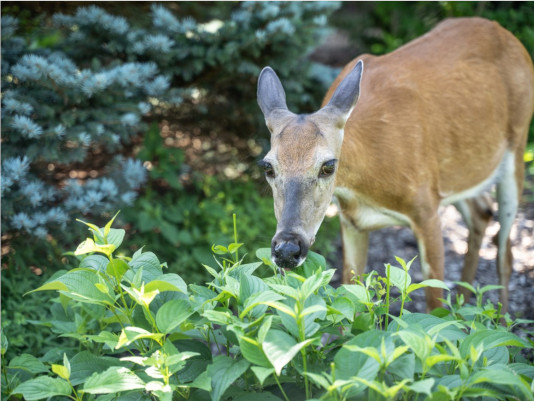
A similar psychology applies to landscaping. Few people buy a deer fence kit or or erect a complete deer fence all around the yard because a few plants have been nibbled. They do so because important parts of their landscaping have been eaten. It’s not just the hostas, which deer love. Its the tulips, the hydrangeas, and even the rhododendrons that contain mildly toxic chemicals in their leaves evolved to discourage browsing. For, despite such evolved defenses, deer can get hungry, especially in winter, hungry enough to eat just about anything. And it’s that kind of devastation which encourages homeowners to act.
Deer Ticks and Lyme Disease
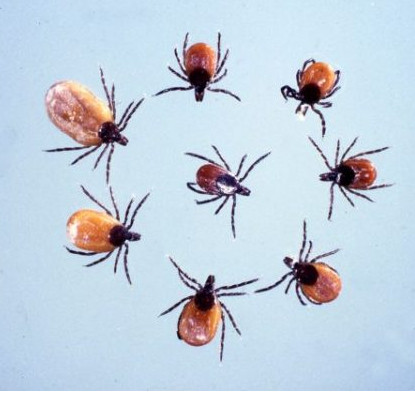
Likewise with deer ticks and Lyme disease. Most people who get Lyme disease don’t get it on woodland hikes but in their own back yards. However, few homeowners get a deer fence system to protect their property just because deer ticks are around.
They might get deer fencing if a family member gets Lyme disease. That’s a little late, however, because the disease is not always curable, and its long-term impact upon an infected person’s joints, nervous system and heart can be severe. As with vegetable gardens and landscaping, however, it is usually true that the need for deer fencing must be clearly demonstrated and direct.
This may be especially true in the case of Lyme disease, because erecting a complete deer fence does not provide immediate or complete protection against the ticks (see Lyme Disease, Deer Ticks, and Deer Fences). However, the deer fence is a critical first step; and the other steps needed, by comparison, are rather small.
Other Signs
Well then, what about less obvious signs you need a deer fence? These may give you no compelling urge to buy a deer fence kit or build a deer fence system. But they may cause you to question friends, neighbors, or previous owners in order to get a true picture of the situation. And that, in turn, may or may not cause you to install a deer fence.
Minor Browsing
Sporadic eating of flowers or vegetables, especially overnight, can be a sign of deer activity.
Here’s what to look for: You’re unlikely to see the deer, which tend to browse at night unless they are strongly established in your neighborhood. What you may see is damaged plants with their flowers, buds, or shoots eaten. Look for plants like day lilies with their buds and/or flowers gone, because deer tend to eat buds and flowers first. Also look for damage to leafy plants like hostas, lettuce, beans, and peas, the two latter often being eaten from the top down. In general, the edges of deer-browsed leaves and stems tend to look ragged or torn, in contrast to the clean-cut leaf edges and stems left by rabbits. And of course,much of the damage done by deer may be out of reach of rabbits or other small critters.
In a similar vein, deer commonly eat the tender leaves, shoots, and buds at the tops of fruit tree saplings, especially in the spring. And of course they can reach reasonably high; so it’s not unusual to see a “browse line” on shrubs and trees like yews and arborvitae, where the foliage has been eaten as far up as the deer can comfortably reach–typically 4 to 6 feet.
Deer Paths, Tracks, and Droppings; Tree Stripping
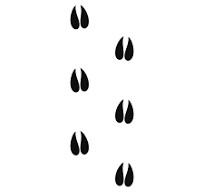
If you come across a deer path, that may mean that deer are well-established in your neighborhood. Such a path, commonly 4 to 8 inches wide, may look like a narrow tunnel through existing grass and other plants, but it has clearly been worn down to bare earth by frequent use.
Whether or not you find a deer path, you may see deer hoof prints and/or droppings. The prints are more or less heart-shaped, with two elongated pointed sides. In the case of white-tailed deer they measure 2 to 3 inches long and 1.5 to 2.5 inches wide. The droppings come in the form of small oval pellets often pointed on one end and measuring 0.5 to 0.75 inches long.
You may also find trees whose bark has been stripped off or damaged. Deer commonly strip bark from young or thin-barked trees like maples, birches, aspens, and apples–primarily for nutrition in winter and early spring. Bucks may also damage trees by rubbing their antlers on the trees to remove velvet from their new antlers and to mark their territory.
Conclusions
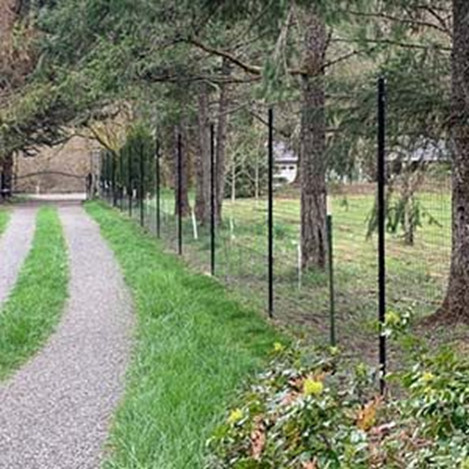
None of these other signs mean that you necessarily need to get a deer fence or kit and install a deer fence. However, they do mean that you should ask around to determine what the deer situation is. Find out if people have seen deer or had deer damage, and very definitely find out whether deer ticks and Lyme disease are present. Clearly, surrounding one’s yard or garden with a tall deer fence, even one that is nearly invisible, is not a minor matter. But neither are the potential destruction wrought by deer or the threat posed by deer ticks minor matters. So it is definitely worth looking for signs of deer, finding out what the deer situation is, and making an informed decision about a fence.