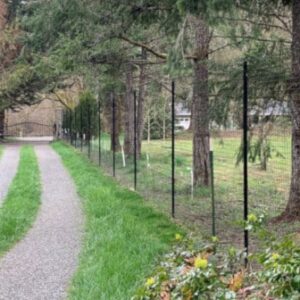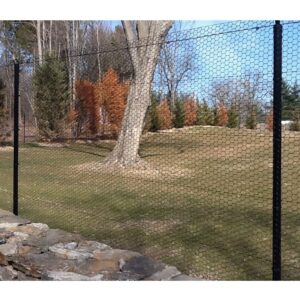

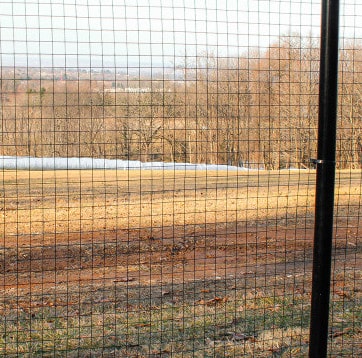
Here’s What You Get from Us:
1) Clarity — a clear description of what you’re getting.
2) Quality — The highest quality, longest lasting deer fencing materials sold anywhere.
3) Reasonable Prices — Because we avoid massive post braces and complex tensioning systems, we are able to offer better for our cost-effective kits than other vendors.
4) Reliability — We’ve been in business over 20 years, and we know how to make fences that reliably keep out deer.
No Gates: Gates are not provided with these kits. Purchase your gates here.
Products included in our 7 x 170-foot kit with black galvanized low-visibility welded wire fencing:
1) Two 8 x 100-foot rolls of black galvanized welded wire deer fencing with 1-inch mesh.
2) 14 Round black galvanized steel posts with sleeves and caps for a fence with a finished height of 7 feet
3) 1 drive caps for installing the post sleeves..
4) Two 100-foot rolls of black stainless steel top support wire with brace bands to make the fencing run straight.
5) 8 earth anchor braces to provide bracing at the corners and ends.
6) 1 hog ring stapler with black hog ring (circular) staples to attach the top support wire to the top of the welded wire fencing.
7) A bag of 100 strong black nylon zip-lock ties.
8) Two bags of 100 strong black stainless steel zip-lock ties.
9) 1 bundle of 30 ground stakes for securing the bottom fold of fencing to the ground.
10) 1 roll of white warning flag tape.
Details:
- The 1″ x 1″ Black Galvanized Welded Wire Fencing, in 8-foot wide rolls, reliably excludes deer and except for our steel web fencing is the least visible quality deer fencing available anywhere. This fencing provides sufficient extra width to create a 12-inch bottom fold.
- The Round Black Posts with Drive Sleeves and Caps, galvanized with a powder-coat finish, are made for fences with a finished 8-foot height. The 2.5-foot-long sleeves make installation easy. Just put the pointed end where you want the post to go, put our drive cap in the open end to prevent damage to that end, and strike the drive cap with a hammer or four-pound mallet (no sledge hammer needed). When about an inch of sleeve is poking out of the ground, remove the drive cap and insert the post. The post hits a crimp one foot down and is installed.
- The Drive Caps are used for driving in post sleeves.
- The Earth Anchor Braces keep heavy snow loads, falling branches, and deer impacts from damaging the fence. These easy to install anchors provide better (stronger, less visible, and less costly) bracing than the heavy posts with side supports commonly used with deer fences. Avoid wires hanging outside the fence by installing them one post back (see our installation instructions).
- The Top Support Wire keeps the fencing running straight and allows the posts to be spaced up to 12 feet apart, even in snow-prone places. Runs of the wire should not go around corners or across gates and should not exceed 60 feet. Crimps for terminating runs of wire provided. This wire and its crimps are also used to attach the earth anchors to brace bands at the tops of their support posts.
- The Brace Bands provide one or more anchor points atop each post for securing the top of the fencing, the top support wire, and the earth anchor braces.
- The Nylon Zip-lock Ties serve to attach the top of the fencing and top support wire to the brace bands and also (in the 100-foot kit) to attach the fencing to the posts.
- The Stainless Steel Zip-lock Ties. These strong black ties serve to attach the fencing to the posts. Use about one tie for every foot of post. Do not use them to attach the fencing and wire to the bolts in the brace bands, because these ties do not close completely.
- The Hog Ring Stapler with Staples. Our black hog ring (circular) staples are used to connect the top of the fencing to the top support wire.
- The Ground Stakes secure the bottom fold of fencing to the ground. Install at least one every six feet.
- The White Warning Flags warn deer away from the fence at night. Tie them on about 10 feet apart at a height of about 3 feet, They can be removed in four months or so, once the local deer have become accustomed to the fence.